The Network and Information Security Directive 2 (NIS2) became enforceable across EU member states in October 2024. For many organizations, the immediate reaction was to hand it off to the IT security team. That instinct is wrong.
NIS2 directly affects privacy compliance programs. It creates incident reporting obligations that overlap with GDPR breach notifications, extends vendor risk management requirements that mirror GDPR Article 28 obligations, and introduces personal liability for senior management in ways that change how privacy programs are funded and governed.
If your privacy team has not yet engaged with your NIS2 implementation, you are operating with a blind spot.
Who Does NIS2 Apply To
NIS2 significantly expands the scope compared to its predecessor. The directive covers two categories of entities: essential and important.
Essential entities include large organizations in sectors such as energy, transport, banking, financial market infrastructure, health, drinking water, wastewater, digital infrastructure, ICT service management, public administration, and space. These face the strictest requirements and the highest penalties.
Important entities cover a broader range of mid-sized organizations in sectors including postal and courier services, waste management, chemicals, food, manufacturing, digital providers, and research.
The thresholds matter: medium-sized companies (50+ employees or €10 million+ turnover) in covered sectors are now in scope. This pulls in thousands of organizations that were previously unregulated under NIS1.
The practical question for your organization: If you are a software company serving healthcare, financial, or public sector clients, you may qualify as a digital service provider under NIS2 regardless of your own sector. Check with your legal team rather than assuming you are out of scope.
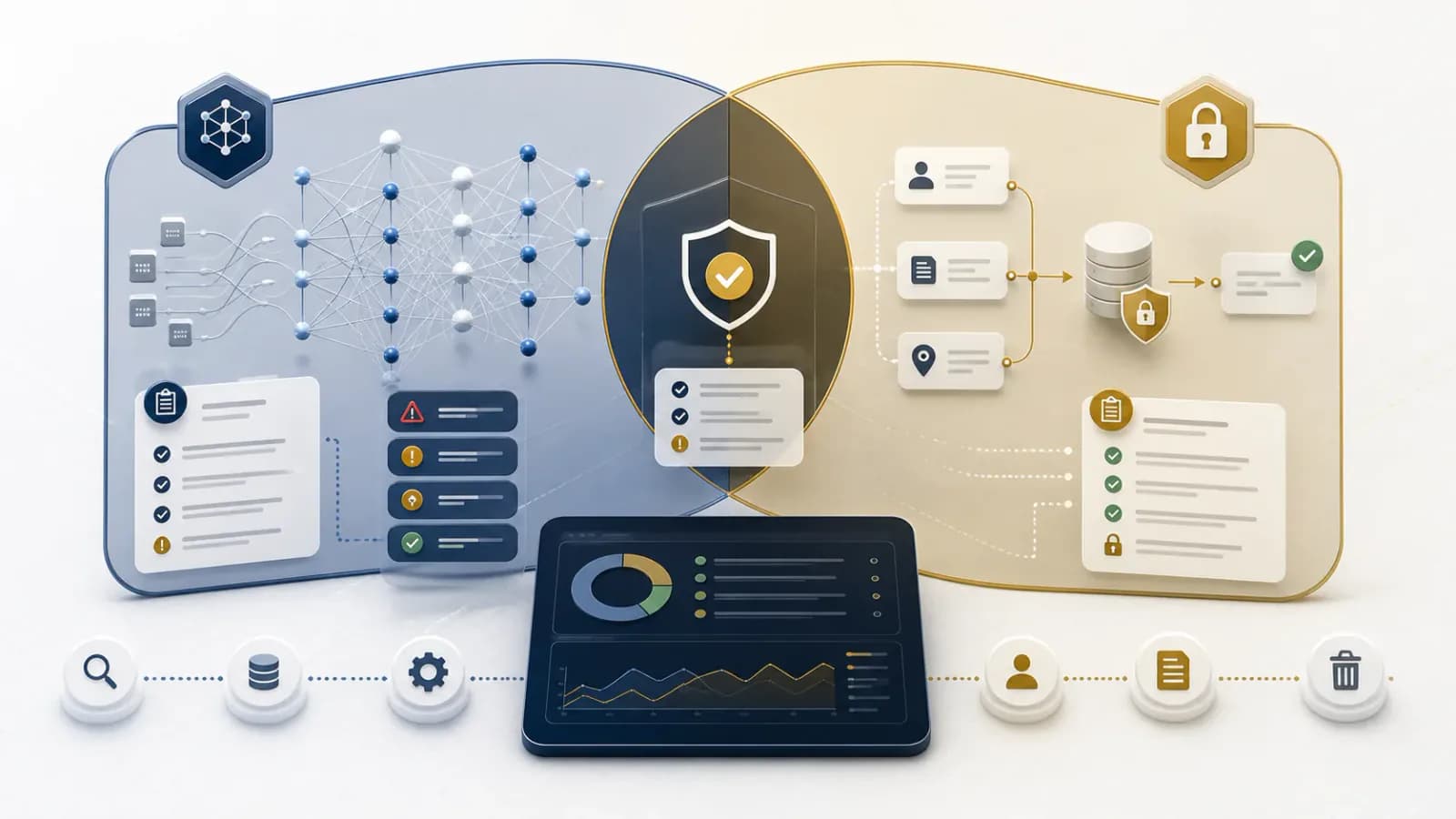
Where NIS2 and GDPR Intersect
Incident Reporting: Two Clocks, Different Timelines
A personal data breach that meets GDPR's notification threshold (Article 33) triggers a 72-hour reporting deadline to your supervisory authority. If the same incident involves critical infrastructure or essential services, NIS2 imposes a different reporting cascade:
- 24 hours: Initial "early warning" to the relevant CSIRT (Computer Security Incident Response Team) or competent authority
- 72 hours: Full incident notification with initial assessment of impact and indicators of compromise
- One month: Final report with full details, root cause analysis, and remediation measures
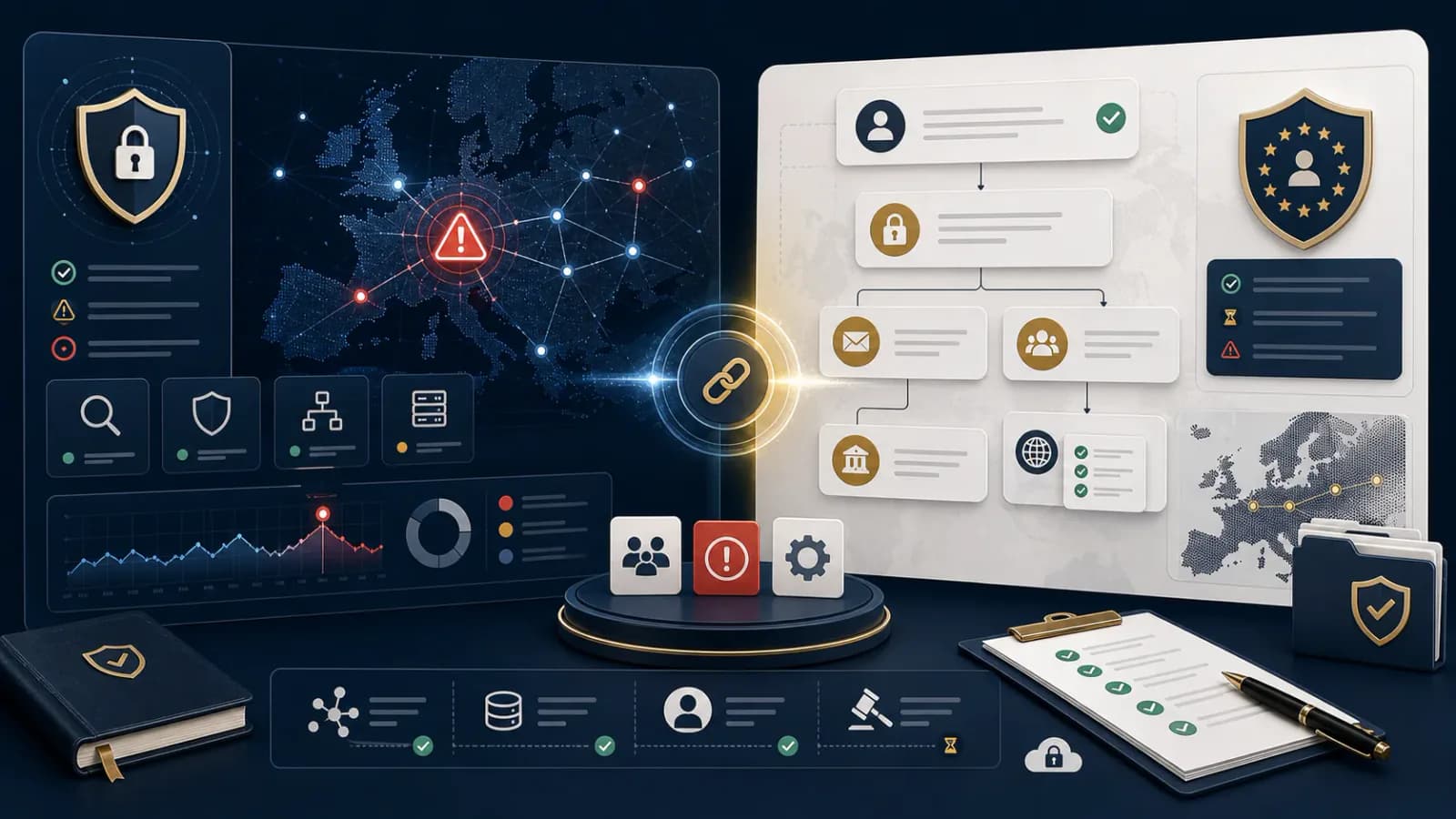
These timelines are not synchronized. A cyberattack that constitutes both a GDPR personal data breach and a NIS2 significant incident requires you to manage two parallel notification processes with different recipients, different templates, and different information requirements.
Organizations that have not mapped these dual obligations are at risk of satisfying one regulator while defaulting on the other. Your DSAR and incident response processes need to accommodate this dual-track reporting structure.
Vendor Management: Same Problem, Higher Stakes
GDPR Article 28 requires written Data Processing Agreements with all processors who handle personal data on your behalf. NIS2 Article 21 requires that essential and important entities manage supply chain security risks — covering the security practices, policies, and contractual arrangements of your suppliers.
In practice, both frameworks require you to assess your vendors, impose contractual security obligations, and monitor compliance. The NIS2 supply chain requirements go beyond data protection to cover the overall security posture of third parties whose products or services could compromise your infrastructure.
The practical implication: your vendor risk assessment process needs to combine GDPR DPA requirements with NIS2 supply chain security checks. Running these as separate programs doubles workload and creates gaps between your privacy and security vendor inventories.
Data Protection Impact Assessments and Risk Assessments
GDPR Article 35 requires a Data Protection Impact Assessment for high-risk processing. NIS2 Article 21 requires organizations to implement risk analysis and information system security policies.
These are different assessments with different scopes: DPIAs focus on risks to individuals from personal data processing, while NIS2 risk assessments focus on risks to network and information systems from threats. But for systems that process personal data and form part of critical infrastructure — an electronic health record system, a banking platform — the risk landscape overlaps substantially.
The most efficient approach is an integrated risk management framework that covers both frameworks, avoids duplication, and ensures consistency between your privacy and security risk registers.
What NIS2 Means for Privacy Program Governance
NIS2 Article 20 imposes a requirement that "management bodies" of essential and important entities must approve cybersecurity risk management measures, oversee their implementation, and undergo training on cybersecurity.
This is significant for privacy professionals for two reasons.
First, it creates a mechanism to get privacy and security investment onto board agendas. Regulatory requirements with personal liability tend to get management attention. NIS2 gives privacy teams a new lever to drive board-level engagement on data protection infrastructure.
Second, it introduces personal liability. Management body members can be held personally responsible for NIS2 compliance failures, with fines of up to €10 million for important entities and €7.5 million for essential entities. For privacy teams, this mirrors the accountability structures that GDPR's Article 5(2) accountability principle was meant to create — but now with explicit personal liability attached.
The Penalty Regime
NIS2 penalties are substantial and imposed at the national level by member state competent authorities:
- Essential entities: Up to €10 million or 2% of global annual turnover (whichever is higher)
- Important entities: Up to €7 million or 1.4% of global annual turnover
These fines are separate from and cumulative with GDPR fines. An incident involving personal data breaches at a critical infrastructure provider could trigger both GDPR fines (up to 4% of global turnover) and NIS2 fines — a combined exposure of up to 6% of global annual turnover.
The enforcement actions we track show that EU regulators are increasingly coordinating cross-framework enforcement. The expectation is that NIS2 enforcement will accelerate through 2026 as member states' competent authorities build capacity.
Practical Steps for Privacy Teams in 2026
Immediate actions
Map your NIS2 scope: Determine whether your organization qualifies as an essential or important entity. If you are uncertain, get a formal legal assessment — the consequences of assuming out-of-scope status incorrectly are significant.
Audit your incident response plan: Review your data breach response procedures against NIS2's dual-notification requirements. Identify who is responsible for CSIRT notification, what information is required, and at what timeline. Update runbooks accordingly.
Review your vendor contracts: Assess whether your existing Data Processing Agreements include the security obligations NIS2 requires. Many older DPAs contain only minimal security clauses that will not satisfy NIS2 supply chain requirements.
Medium-term actions
Integrate risk assessments: Develop a unified risk assessment template that covers both GDPR Article 35 DPIA requirements and NIS2 Article 21 risk analysis requirements. This avoids duplication and creates a single source of truth for privacy and security risk.
Brief senior management: Use NIS2's personal liability provisions to initiate board-level conversations about privacy and security investment. Prepare a concise briefing that maps NIS2 obligations, the gap between current state and compliance, and the remediation investment required.
Build evidence of compliance: NIS2 requires organizations to demonstrate their security measures are implemented and effective. Integrate NIS2 compliance evidence capture into your existing privacy compliance evidence trail. Both frameworks require documented, auditable proof of compliance — maintain a single evidence repository that serves both.
The Bottom Line
NIS2 is not the IT team's problem. For any organization in scope, it is a compliance obligation that intersects substantially with GDPR in incident response, vendor management, risk assessment, and governance.
Privacy teams that engage with NIS2 proactively gain influence over security investment decisions, simplify compliance by integrating overlapping requirements, and avoid the compounding penalty risk of treating privacy and security as separate domains.
The organizations that will navigate 2026's regulatory environment most effectively are those that have stopped treating GDPR and NIS2 as separate problems — and started building integrated compliance programs that satisfy both simultaneously.